When a vehicle arrives at a community organisation with food, there is more to record than the delivery itself. What was handed over? How much did it weigh? Who received it? And how do you capture that information when there is no internet connection?
These details help us account for the food we move and coordinate support for our community partners. Alongside vehicles and warehouses, food rescue depends on reliable information.
Our mission is to eradicate hunger in South Africa. Rescuing surplus food and connecting it with community organisations is a practical part of that work, supported by relationships, logistics and technology.
Our technology platform helps track food through collection, warehousing and delivery. Three Emeris students explored how tools for managing donor relationships and recording food handovers could support the processes around that journey.
From classroom learning to a real brief
Janco Pretorius, Keegan Blane Rees and Tristan Daniel Elliott connected with SA Harvest through their Work Integrated Learning module. Their task was to partner with a non-profit and develop software addressing a real need.
“What drew me to this project was the opportunity to solve a real problem rather than work through a purely academic scenario,” says Janco, who is studying BSc Computer Science at Emeris in Pretoria.
Shaun Henshilwood, our Head of Technology, helped the team understand how donor relationships and food handover records are managed. Regular discussions and demonstrations grounded the project in our teams’ working conditions, including unreliable connectivity, data security requirements and the need to work with Foodspace, our core platform.
Designing around the people doing the work
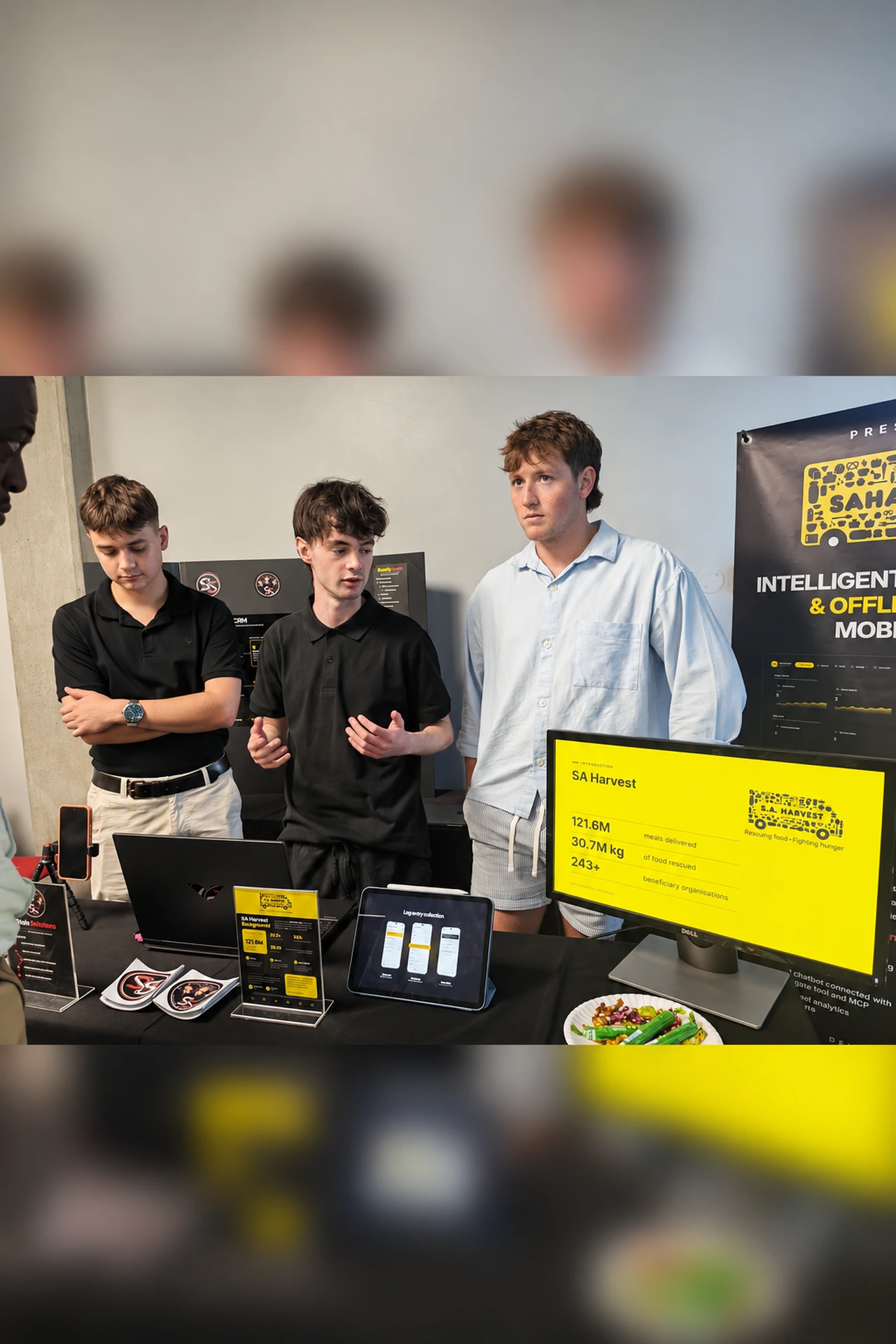 The students showcase their donor management and mobile app projects, exploring practical ways to support donor relationships and food handover records.
The students developed a web-based donor relationship management system and an Android mobile app.
The donor system demonstrates how organisations could submit their details and supporting documents through a guided process, while staff could record interactions and manage follow-ups. Better access to this information could help our teams coordinate contributions and maintain the relationships that make food rescue possible.
The mobile app was designed to capture food handover information, including products, weight, temperature, signatures and photographs. Its offline functionality would allow records to be completed without a connection and synchronised when signal returns. This would help address the challenge of recording information in areas with limited connectivity.
Keegan, who is studying Computer and Information Sciences specialising in Application Development, identified the offline functionality as his proudest achievement. Building it required him to map how information would move between different parts of the proposed system.
“Once I could picture how the data would flow and how each part fit into the bigger architecture, the problem became far more manageable,” he explains.
The tools remain student projects, offering a working example to inform future systems planning. Integration with Foodspace was explored as a design goal.
Learning to listen, plan and adapt
The project required the students to look beyond what the technology could do and consider how people would use it during a working day.
Janco’s experience reinforced the importance of planning and setting clear boundaries. With many possible features to develop, guidance from Shaun helped keep the project focused on the agreed needs.
Shaun was impressed by the team’s professionalism, attention to testing and documentation, and willingness to respond to feedback.
“They designed for the person using the tool, not just a list of features,” says Shaun.
The exchange brought value to both sides. The students gained experience of real operational constraints, while SA Harvest gained fresh thinking about donor management and food handover records.
Taking their work to the expo
On 3 November 2026, the team presented their project at the Emeris student expo in Pretoria. Marketing Co-ordinator Maphefo Monyepao, Shelly Abbey and Head of Operations Eugene Kriel attended to support them.
Keegan described the presentation as a rewarding opportunity to explain work that had involved months of effort, late nights and bug fixes. He also reported positive feedback from lecturers about how the applications worked together.
Our attendance recognised the time and skills the students contributed at no cost, and the care they took to understand our work.
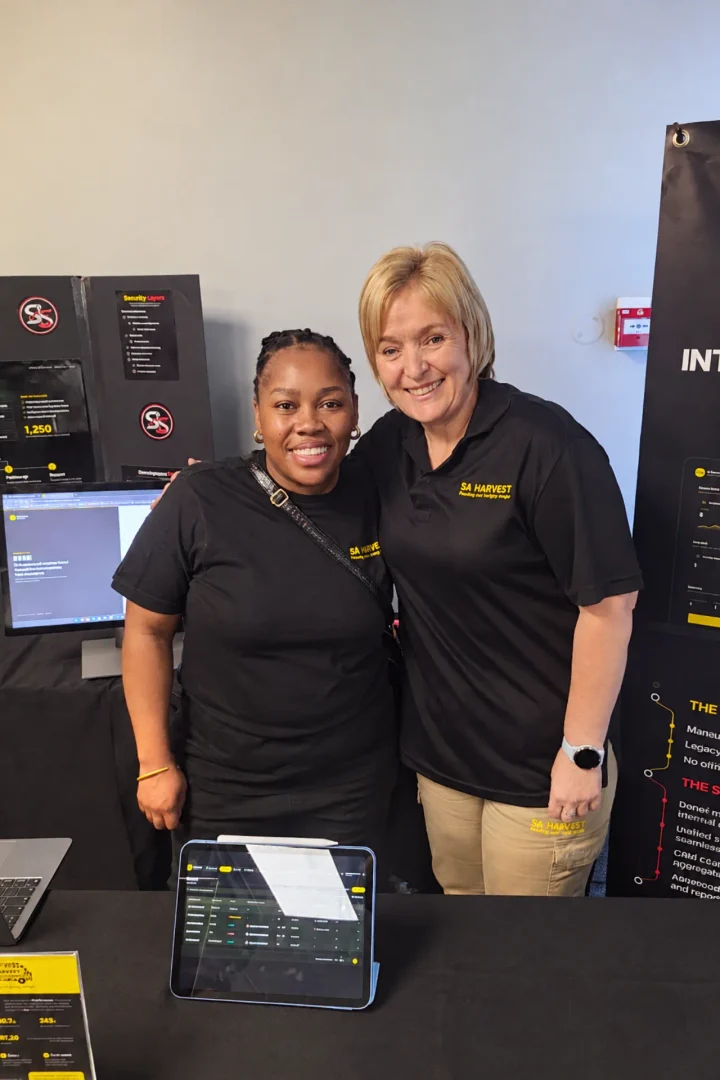 Maphefo Monyepao (left) and Shelly Abbey support the Emeris students at the expo, recognising the time, skills and care they brought to the project.
Thank you, Janco, Keegan and Tristan, for applying your learning to the practical challenges behind food rescue.
Eradicating hunger takes contributions from many people and disciplines. This collaboration shows how young developers can bring useful ideas to the relationships, records and coordination behind getting food to communities.
Donate to SA Harvest to support the people, logistics and technology that keep food moving.