World Environment Day can feel too large to touch. Climate change is often spoken about through global temperatures, extreme weather, energy systems and international agreements.
But sometimes the climate question is much closer to home:
What happens to good food when the system fails to move it in time?
In 2026, World Environment Day focuses on climate change and the signals the Earth is sending, as well as the signals we choose to send back. UNEP’s campaign calls on people, businesses and governments to step in #NowForClimate.
For South Africa, one of those signals is already visible in our food system.
We waste millions of tonnes of food each year, while many households still struggle to access enough food reliably. WWF’s Food Loss and Waste: Facts and Futures report states that South Africa wastes around 10 million tonnes of food every year, about a third of the food produced nationally. Statistics South Africa’s 2023 food security report also shows that 19.7% of South African households experienced moderate to severe food insecurity, while 8% experienced severe food insecurity.
That is not only a hunger story, but a clear climate story. It is also a systems story, because surplus food does not become impact by accident. It becomes impact when donors, logistics, cold chain, warehouses, drivers, data, fuel, route planning and community-based organisations work together before good food becomes waste.
Based on SA Harvest’s internal food rescue data analysed for this World Environment Day campaign, here are the clearest lessons.
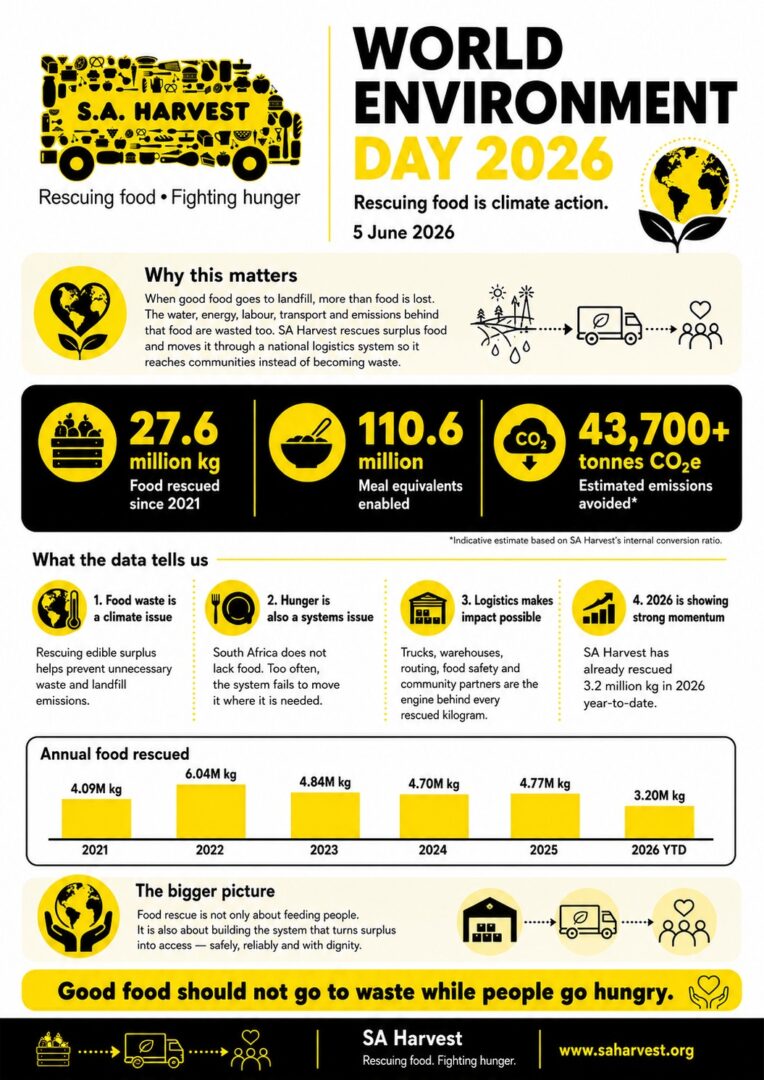 SA Harvest’s food rescue impact and climate contribution for World Environment Day 2026.
1. Food waste is not only a moral failure. It is a climate failure.
Most people understand food waste as a human contradiction: good food is discarded while people go hungry.
That is true. But it is not the whole story: When food is wasted, everything behind that food is wasted too: the water, land, labour, electricity, packaging, refrigeration, storage, transport and fuel that helped produce and move it. And when food is lost to landfill, the climate cost continues.
This is why food rescue should not be treated as soft charity work. Done properly, it is climate action with operational discipline behind it. A meal does not begin on a plate. It begins with a system.
2. The most practical climate work often looks like logistics.
Climate action is often visualised through solar panels, wind farms, electric vehicles and tree planting.
But sometimes climate action looks like a truck arriving on time. A warehouse receiving stock. A food donor flagging surplus early. A cold room keeping rescued food safe. A driver completing a route before good food becomes unusable.
That is the less obvious lesson in SA Harvest’s work. The impact does not happen simply because surplus food exists. It happens because there is a system capable of moving it.
Food rescue is infrastructure. And in a country where hunger and waste exist side by side, infrastructure is not a technical detail. It is the difference between loss and access.
3. Since 2021, SA Harvest’s working data shows more than 27.6 million kg of food rescued.
SA Harvest has rescued approximately 27.64 million kg of food from 2021 to 2026 year-to-date. Using SA Harvest’s meal-equivalent conversion, that represents more than 110 million meal equivalents.
The phrase “meal equivalents” matters. It is an impact measure. It does not claim to prove how many individual people ate, how often they ate, or the full nutritional composition of every meal. But it does show something powerful.When good surplus food is captured in time, waste becomes access. Not charity. Access.
Using SA Harvest’s working climate-impact estimate, this food rescue activity also represents an indicative 38 million kg of CO₂e avoided. This figure should be treated as an internal communications estimate unless and until the methodology is formally verified for ESG or carbon reporting.
4. The real surprise is not that food is wasted. It is how much of it can still move.
Food waste is often framed as inevitable: food expired, spoiled, overstocked, mislabelled, overproduced or stranded somewhere in the supply chain.
But SA Harvest’s data tells a more useful story: Some food waste is preventable. Some is recoverable. Some is simply stuck in the wrong part of the system. That changes the question.
Instead of only asking, “How do we produce more food?”, South Africa must also ask: How do we stop losing the good food already in the system?
That is a climate question. It is also a logistics question. And it is one of the most practical food access questions facing the country.
5. Reliable food partners create repeatable climate impact.
The donor data shows a concentration effect: a relatively small group of high-volume food donors and aggregation partners account for a major share of the food rescued.
It is a key strategic lesson. Climate impact at scale depends on repeatable systems, not occasional generosity.
For retailers, manufacturers, producers and food businesses, the biggest impact does not come from a once-off donation photo. It comes from embedding surplus recovery into ordinary operations: store-level processes, warehouse decisions, stock management, production planning, logistics and reporting.
That is where food rescue becomes commercially relevant. It helps reduce waste. It protects value. It strengthens ESG evidence. It turns surplus into measurable social and environmental impact.
The strongest corporate partners are not just sponsors of good work. They are system partners in making the work possible.
6. Food rescue is one of the few climate actions that also works immediately for communities.
Some climate interventions take years before their social benefit is visible. Food rescue works faster in that when surplus food is safely captured and moved through a trusted redistribution network, the climate and social benefits happen together. More food moves toward community kitchens, early childhood development centres, shelters and other trusted community-based organisations, less food moves to landfill. That matters because CBOs are not passive recipients. They are last-mile community infrastructure. They know the households, children, elderly people and families who carry the daily weight of food insecurity.
Food rescue does not replace the need for deeper economic reform, social protection or food-system resilience, but it does do something immediate and practical.
It closes part of the gap between surplus and access.
7. The real story is not “feeding people”. It is fixing the gap between surplus and access.
This is the most important World Environment Day takeaway: Good food exists. Too often, it does not reach the people who need it before it becomes waste.
SA Harvest helps close that gap through food donors, logistics, warehouses, cold chain, data, food safety, community partnerships and operational discipline.
That is why the climate story matters. It reframes food rescue as infrastructure. And it reminds us that hunger is not only a scarcity problem. It is also an access, coordination and distribution problem.
Food waste is often treated as the end of the story: something expired, spoiled or was lost. But the better question is what happened before that.
For companies, funders, logistics partners and food donors, that is where the opportunity lies.
Not in pity.
Not in once-off generosity, but in building the systems that make care count.
Read about our Environmental Month Campaign here.