Every meal has a history before it reaches a plate.
It begins with soil, water, seed, labour and time. It moves through farms, packhouses, factories, trucks, warehouses, shop floors and kitchens. By the time food is ready to be eaten, it has already carried a long chain of resources with it.
So when good food is wasted, we lose more than the food itself.
We lose the water used to grow it. The energy used to process and cool it. The fuel used to move it. The packaging around it. The labour behind it. And, finally, if that food ends up in landfill, we add another environmental cost to a system already under pressure.
That is why food waste belongs in South Africa’s Environmental Month conversation.
It is easy to think about the environment in terms of oceans, plastic, trees, energy or emissions. Those issues matter deeply. But food waste sits quietly inside all of them. It is a climate issue, a water issue, a land-use issue, a waste-management issue and, in a country facing deep food insecurity, a human issue too.
Globally, food loss and waste account for an estimated 8–10% of annual greenhouse gas emissions. South Africa’s own food waste challenge is significant, with an estimated 10.3 million tonnes of food wasted each year. The research also shows that much of this loss happens before food ever reaches a household bin — across processing, packaging, storage, distribution and other points in the food value chain.
That matters because it changes the kind of solution we need.
Household awareness is important. We should all waste less food at home. But if a large part of the loss happens earlier in the chain, then the response has to reach earlier too. It has to work where surplus appears, where food is at risk of being discarded, where cold storage is needed, where transport can make the difference, and where trusted community partners can receive and use food safely.
This is the space where food rescue does its most important work.
Before good food becomes waste, it can still become nourishment
The best outcome is always to prevent food waste before it happens. But in the real world, surplus food is part of the food system.
Crops come in larger than expected. Packaging changes. Retailers have short-dated stock. Manufacturers have overruns. Events have surplus prepared food. Farmers face market or timing mismatches. Sometimes food is perfectly edible, but commercially difficult to sell.
In those moments, speed matters. So does trust.
Good food needs to be identified, collected, checked, stored, routed and redistributed before time runs out. That work is practical. It depends on people, systems and infrastructure.
It depends on food donors who are willing to act responsibly.
It depends on vehicles, drivers, cold rooms, warehouses and route planning.
It depends on food safety processes that protect everyone involved.
It depends on community-based organisations that know their communities and can turn food into daily support with dignity and care.
This is why food rescue is one of the most practical meeting points between environmental responsibility and food access. It keeps edible food in the human chain for as long as possible. It reduces avoidable waste. It helps protect the resources already invested in that food. And it supports people through organisations rooted in their communities.
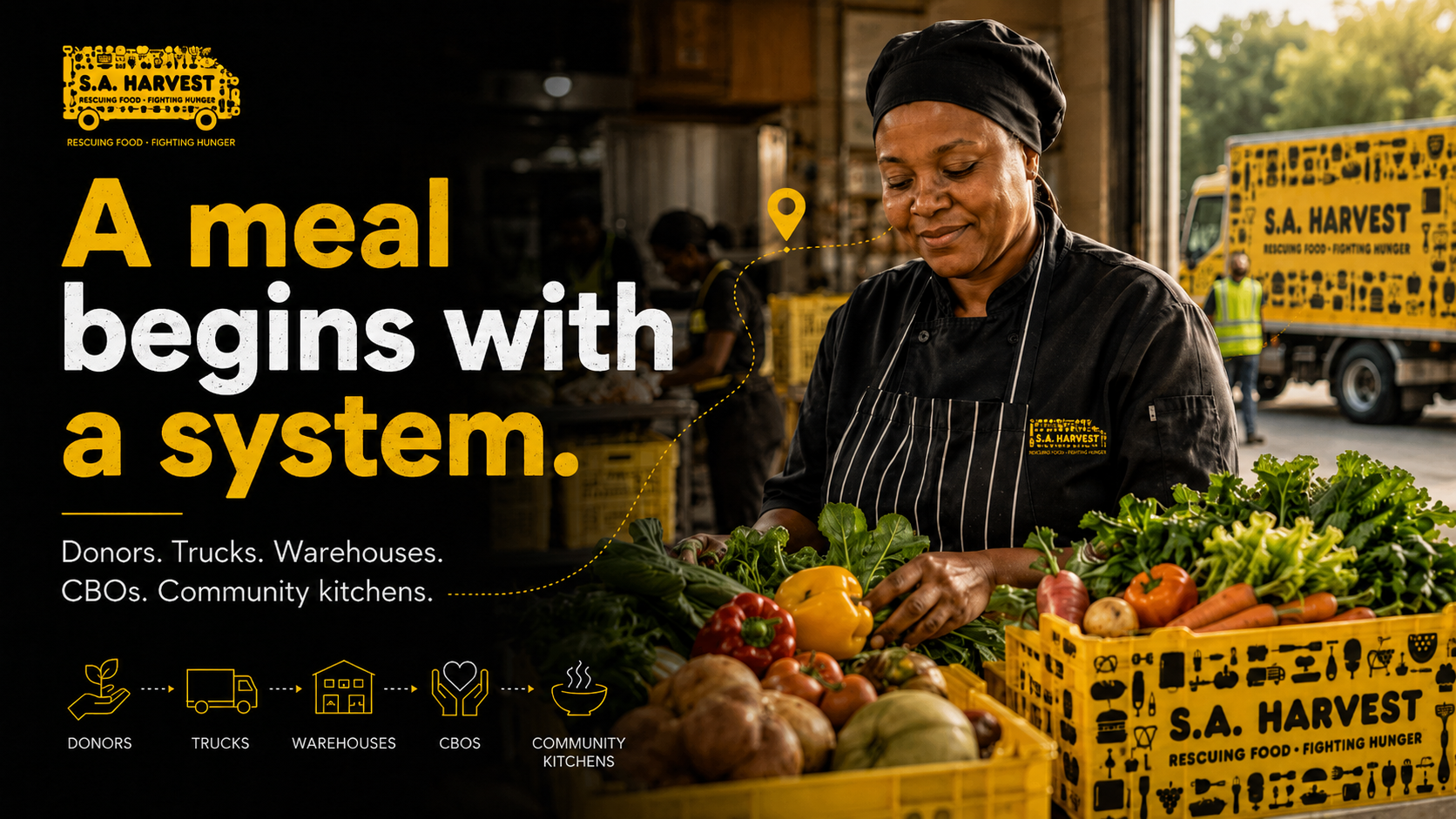 Behind every rescued meal is a system: donors, trucks, warehouses, CBOs and community kitchens.
The journey behind a rescued meal
Most people see the final moment: a meal served, a parcel packed, a kitchen preparing food for the day.
The journey before that moment is less visible.
A donor alerts SA Harvest to available surplus. A team checks what the food is, how much there is, where it is, how quickly it needs to move and whether it requires cold chain. A route is planned. A driver collects. A warehouse team receives, sorts or redirects. A community-based organisation is matched to the food. A kitchen prepares. A family, child, older person or community member receives nourishment because a chain of decisions worked in time.
That chain is where the real story sits.
Food rescue is not a single gesture. It is a series of small, disciplined acts that must happen in the right order: the call answered, the truck dispatched, the temperature protected, the paperwork done, the route adjusted, the food checked, the partner ready.
It is care made operational.
And when it works, food that could have become waste becomes access.
Why SA Harvest’s work matters during Environmental Month
SA Harvest’s role is to help build and operate the system that connects surplus food to people who need it.
That means working with food donors, logistics partners, warehouses, cold-chain capacity, data systems and vetted community-based organisations. It means treating community kitchens and CBOs as essential last-mile infrastructure. It means recognising that trucks, fuel, cold rooms and route planning are part of the food access story.
During Environmental Month, this matters because climate action needs practical examples people can understand.
Food rescue offers one.
It takes a problem that can feel enormous — waste, emissions, hunger, inequality, climate pressure — and shows a route into action. A business with surplus food can act. A logistics partner with available capacity can act. A corporate funder can act. A member of the public can act. A community organisation can act. Each contribution strengthens the chain.
The environmental value is not separate from the human value. The same action that keeps food out of waste streams can help get food into kitchens where it is needed.
That is a powerful form of shared impact.
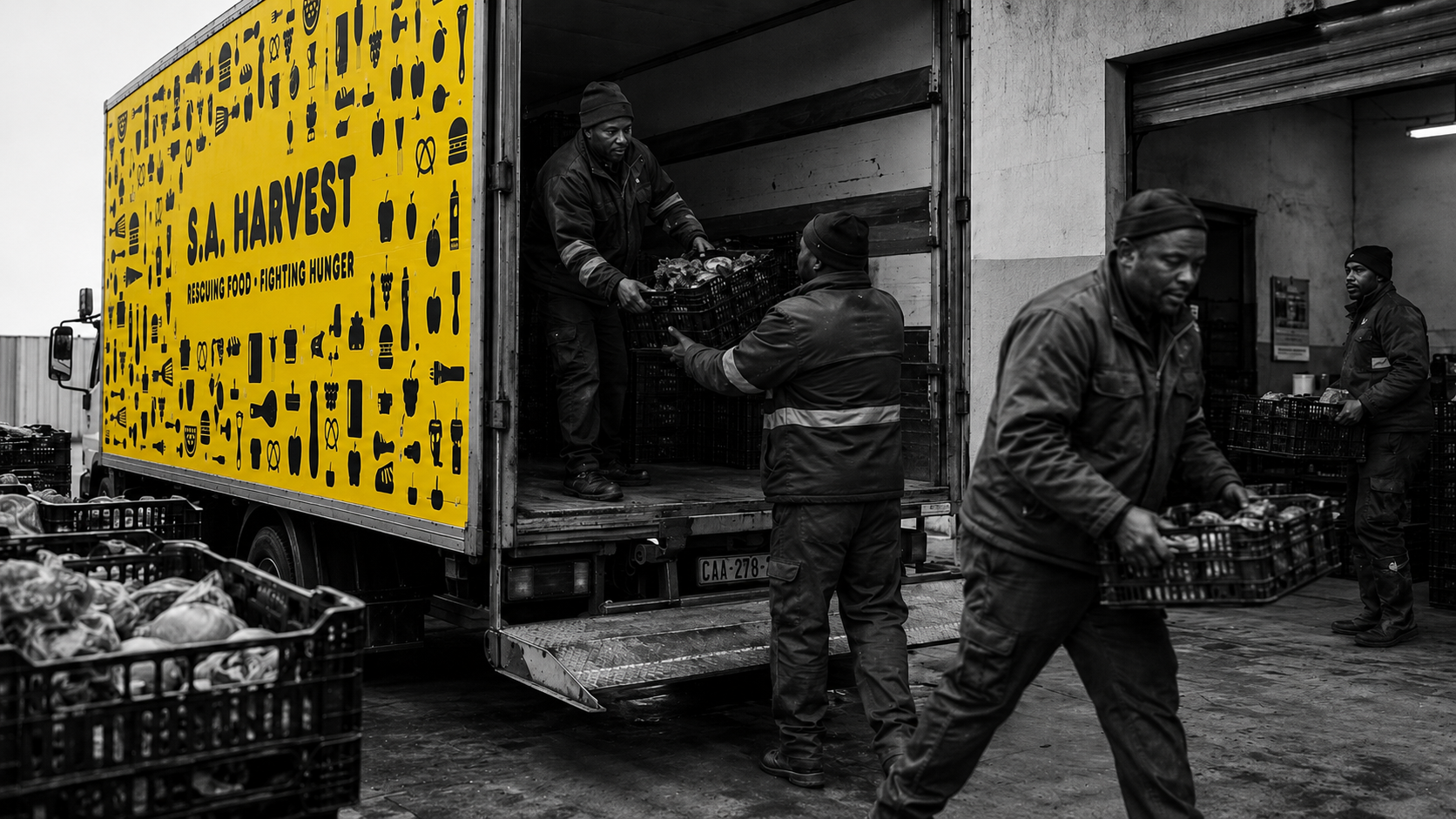 Good food should not become waste because the system failed to move it in time.
A better food system is built in ordinary places
A better food system is not built only in policy rooms or global conferences.
It is built in loading bays, warehouses, cold rooms, trucks and community kitchens. It is built through a retailer deciding to donate surplus responsibly. Through a manufacturer making a regular food donation process easier. Through a logistics company using capacity that might otherwise return empty. Through a funder understanding that operating costs are not overheads when they keep the system moving. Through a CBO receiving food safely and using it with care.
These places may not always look like climate action. But they are. Every rescued kilogram of edible food carries an environmental story and a human one. It represents resources that do not have to be wasted, and nourishment that can still reach people. This is the kind of climate action South Africa needs more of: practical, visible, collaborative and rooted in the realities of daily life.
How to be part of the system
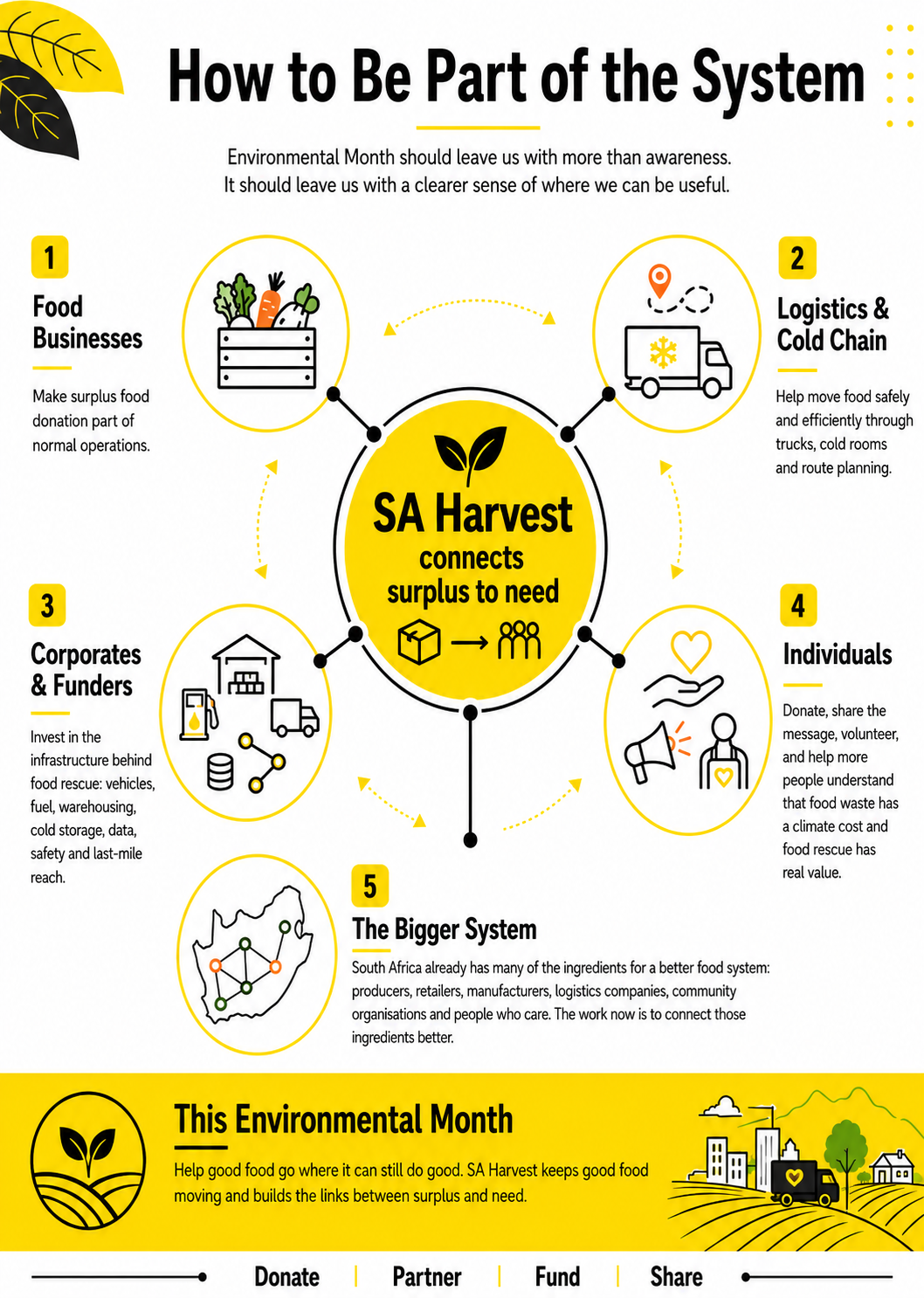
Environmental Month should leave us with more than awareness. It should leave us with a clearer sense of where we can be useful.