At the Road Freight Association (RFA) Convention this weekend, Liesl De Wet, Chairperson of the RFA Green Transport Working Group, delivered a message that should resonate across South Africa’s logistics and supply chain sectors: fuel volatility, climate risk, customer expectations and emerging technologies are no longer distant sustainability concerns. They are operational realities shaping business today.
Her message was simple but powerful. Transport companies are no longer being asked merely to move goods from A to B. They are being challenged to measure performance more accurately, optimise routes, reduce emissions, improve driver training, manage energy consumption and prepare for a future where low-carbon logistics is a business necessity. As De Wet noted, “fuel costs are volatile and efficiency equals survival.”
Why Green Transport Matters for Food Rescue
For SA Harvest, this is not an abstract industry discussion. It sits at the very heart of effective food rescue.
June marks South Africa’s National Environment Month, with World Environment Day taking place on 5 June. It is an ideal time to recognise that food waste is not simply a household behaviour issue. It is fundamentally a systems issue.
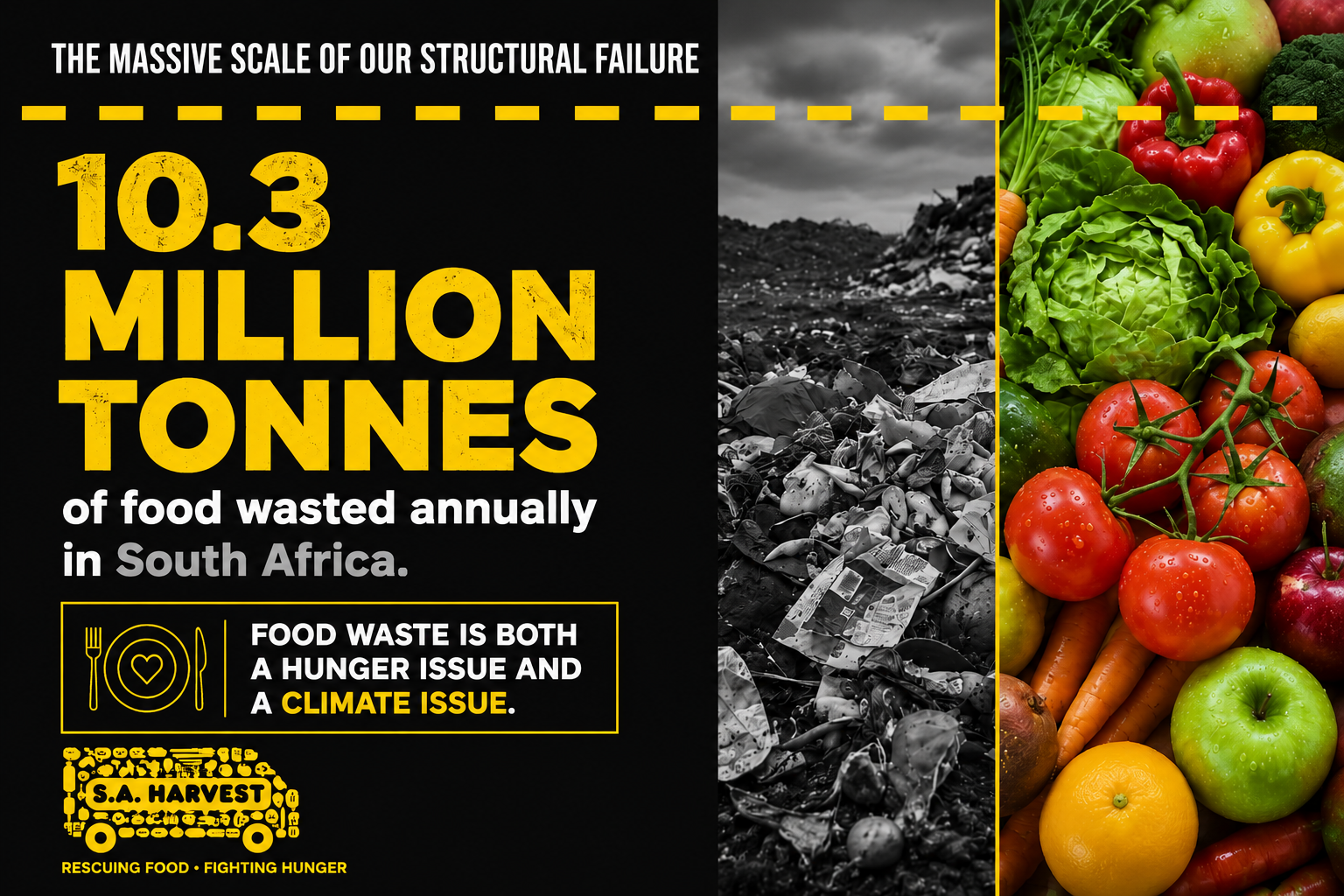
Globally, food loss and waste account for an estimated 8–10% of annual greenhouse gas emissions. In 2022 alone, approximately 1.05 billion tonnes of food waste were generated across retail, food service and household sectors. In South Africa, the Department of Forestry, Fisheries and the Environment estimates that 10.3 million tonnes of food are wasted every year.
Food does not become waste solely because people are careless. Often, it becomes waste because systems fail to connect quickly enough.
The Logistics Behind Food Rescue
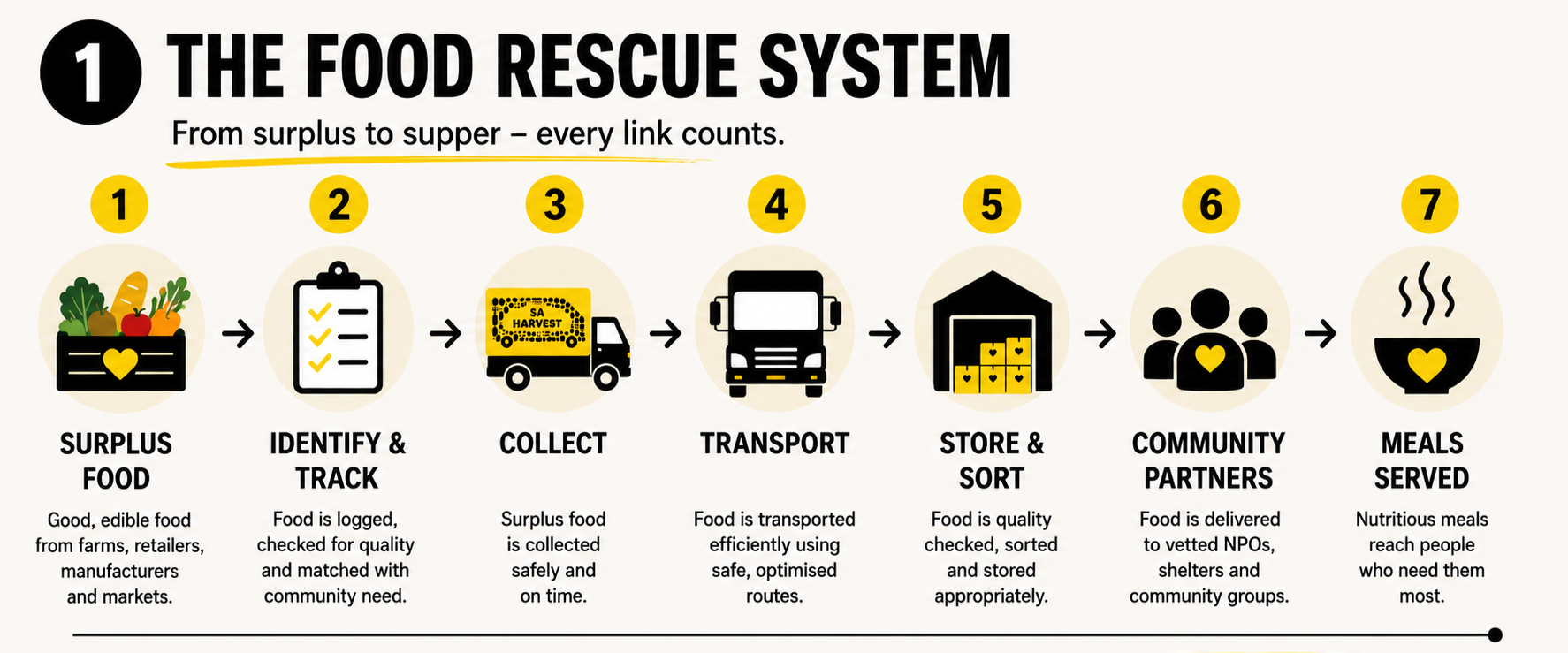
Food must be identified, collected, transported, stored, inspected, sorted and redistributed while it is still safe and nutritious. Perishable products require cold-chain management. Short-dated stock requires speed. Rural and township communities need reliable last-mile delivery. Community-based organisations (CBOs) require consistency. Donors need transparency and traceability.
All of this depends on the same principles highlighted by De Wet: measurement, data, route optimisation, operational efficiency, driver training, preventative maintenance, load planning, energy readiness and collaboration.
This is why SA Harvest’s National Environment Month message is clear: food rescue is climate-aligned infrastructure.
Food rescue is not simply about diverting food from landfill. It is about keeping edible food within the human food chain through the systems and infrastructure required to move it where it is needed most.
Behind every rescued meal is a network of trucks, warehouses, routes, cold rooms, donor partnerships, vetted CBOs, traceability systems and reliable last-mile delivery solutions.
First Gear: Visibility and Measurement
One of the key themes from the RFA Green Transport Working Group is that sustainability begins with visibility.
For SA Harvest, this means knowing where food is located, its condition, where it needs to go, how quickly it must move and the impact created when it arrives.
Data is not administrative paperwork. It is the mechanism that transforms surplus food into measurable, accountable impact.
Second Gear: Operational Efficiency
The next step is operational efficiency.
This is where sustainability becomes practical through improved driver behaviour, route planning, load optimisation, tyre management and preventative maintenance.
In food rescue operations, these details matter enormously. A poorly planned route can result in food arriving too late. A break in the cold chain can compromise food safety and dignity. An under-utilised vehicle is not merely a cost issue—it is a missed opportunity to deliver more food to more people.
Third Gear: Smarter Technology and Sustainable Logistics
Technology also plays a critical role in the future of green transport.
Electric vehicles, hydrogen solutions, telematics, alternative fuels and charging infrastructure all have a place in South Africa’s transport transition. However, as De Wet emphasised, there is no single solution.
The shift toward sustainable logistics will require a combination of technologies, supportive policies, energy planning, skills development and industry collaboration.
Climate-smart logistics cannot be built on slogans. It must be designed around real-world factors such as route requirements, cargo types, distances travelled, energy availability, affordability and total cost of ownership.
Why This Matters for South Africa’s Food System
This lesson is particularly relevant for food rescue.
A cold-chain vehicle operating without the right route planning, loading strategy, driver expertise or receiving capacity does not solve the problem. It simply relocates the bottleneck.
The real opportunity lies in building smarter logistics systems. This includes using data to reduce wasted kilometres, improving backhaul opportunities, strengthening warehousing capacity, leveraging available transport capacity and connecting surplus food more rapidly with community kitchens and CBOs.
This is where South Africa’s freight and logistics industry can make a transformative contribution.
Green Transport and Food Security Go Hand in Hand
For many people, hunger relief is represented by a meal on a plate. Yet before that meal reaches someone in need, there is an entire logistics ecosystem at work.
There is a route. A driver. Fuel. A truck. A warehouse. A cold room. A receiving process. A community kitchen.
Most importantly, there is a decision to ensure that good food does not become waste simply because the system failed to move it in time.
The RFA Green Transport Working Group’s focus on collaboration therefore represents more than an industry initiative. It represents a national opportunity to strengthen South Africa’s food system.
If the logistics sector is already investing in greener routes, cleaner energy, smarter fleets, stronger infrastructure and better data, then food rescue should be part of that conversation.
Building a Stronger Future Through Smarter Logistics
When transport becomes more efficient, food rescue becomes more scalable.
When cold-chain systems improve, more nutritious food can be delivered safely.
When data becomes more accurate, impact becomes easier to measure.
When empty return trips are utilised effectively, surplus food becomes food access.
When logistics providers see themselves as partners in food security, South Africa gains more than greener transport. It gains a stronger system for connecting available resources with urgent need.
As National Environment Month reminds us, awareness alone is not enough. We must also understand where we can contribute.
For SA Harvest, the lesson from the RFA Convention is clear: the future of food rescue will not be built on goodwill alone. It will be built by the people who understand movement—freight operators, cold-chain specialists, warehouse teams, drivers, data experts, retailers, manufacturers, donors, CBOs and funders.
A greener transport industry is not separate from the fight against hunger.
It is part of the infrastructure that makes food access possible.
And in a country where enough food exists, yet too much of it still fails to reach people in time, that infrastructure is not a side issue.
It is the work.
Food rescue is climate action. Learn more in SA Harvest’s Food Waste Has a Climate Cost campaign.