The beginning of a new year often brings good intentions: promises to do better, to give more, to show up differently. But real change doesn’t begin with intention. It begins when food moves.
This January, Outside the Bowl Africa made a practical decision: to place 21,000 individual ready-made meals into a system that could move them quickly, safely, and at scale.
The meals, were allocated deliberately: 25% to communities in the Boland, with the remainder integrated into SA Harvest’s national redistribution network.
This was done with no ceremony, but one can safely say it was based on urgency, coordination, and trust.
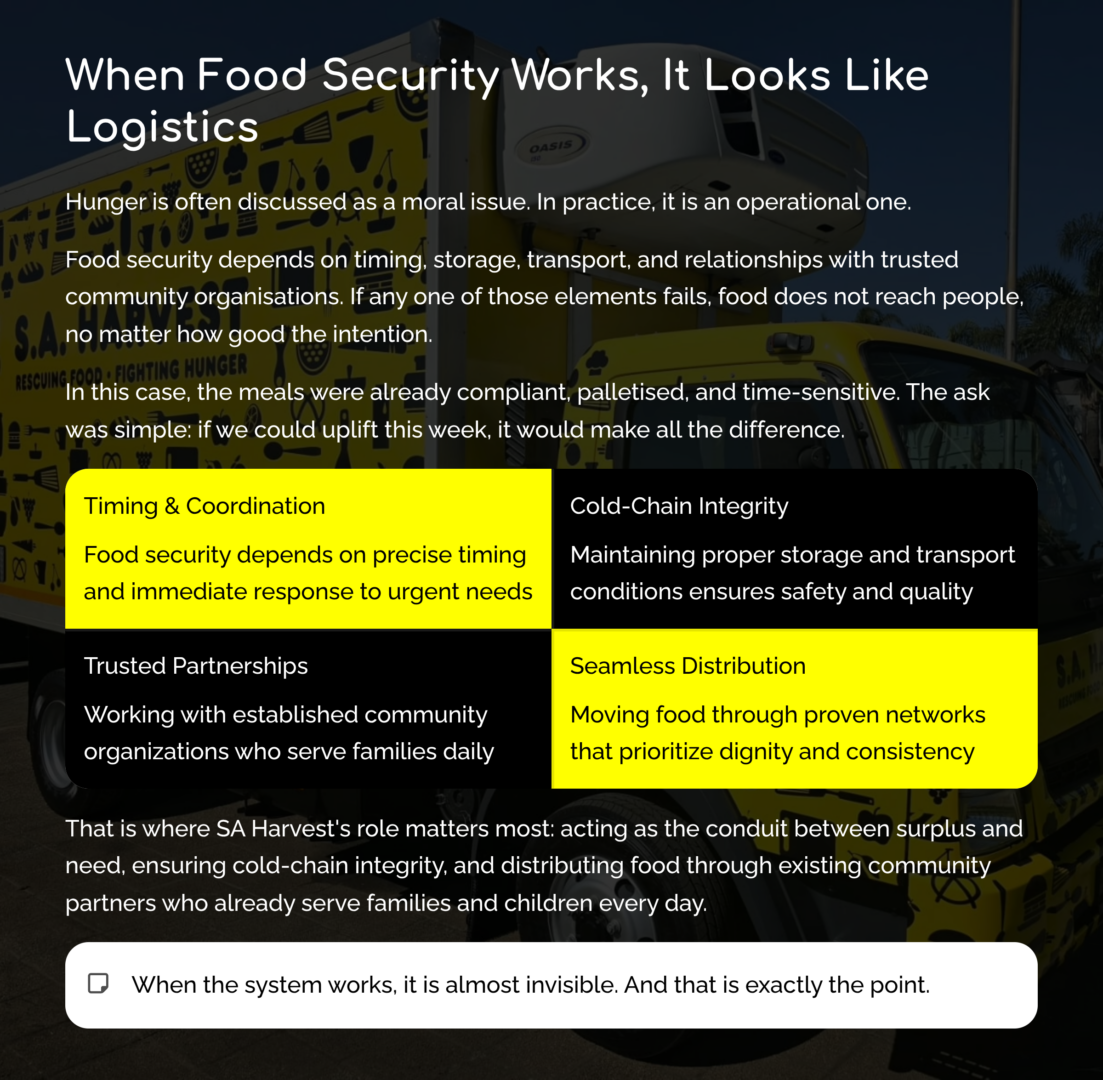
A Partnership Built on Trust
What makes this collaboration meaningful is not only the number of meals, but the way responsibility was shared. Outside the Bowl Africa did not dictate outcomes, but rather trusted the SA Harvest system.
By allocating a portion of the meals to the Boland and allowing the rest to flow through SA Harvest’s national network, the partnership respected both local impact and national intelligence about need.
This is how scale is achieved without duplication, and how dignity is preserved without spectacle.
From Warehouse to Community
As the pallets move from cold storage into distribution, the story unfolds quietly, through warehouse teams, drivers, and community organisations who understand that hunger does not wait for press moments.
The meals will reach families not as a once-off gesture, but as part of an ongoing network of support that prioritises consistency, safety, and respect.
We extend our sincere thanks to Mark Maingard and the Outside the Bowl Africa team for choosing collaboration, speed, and substance.
This partnership is a reminder that progress does not always announce itself loudly. Sometimes, it arrives on pallets, in cold storage, ready to move.
An Invitation to Participate
Hunger will not be solved by goodwill alone. It will be solved when more organisations choose to place food, resources, and trust into systems that work, whether through surplus contributions, logistics support, partnerships, or advocacy.
This is how food security becomes operational. And how change begins, one decisive step at a time.